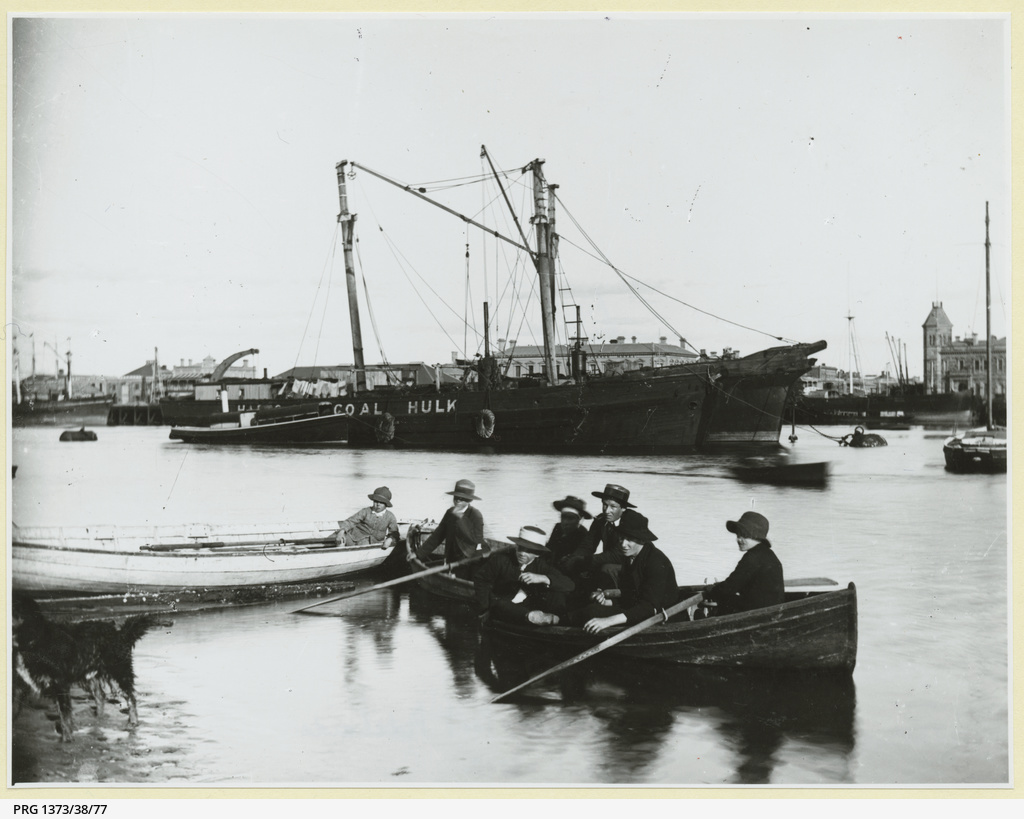
On 3 October 1879 the Sarah Burnyeat was driven ashore at Lockeville and condemned as a wreck. The barque was sold and underwent extensive repairs. The rig was changed to brig during the repairs.
The Sarah Burnyeat arrived in Albany in early May 1882 with a cargo of coal from Newcastle, NSW. In June 1883 the owners, Lilly and Marshall, sold the brig to the Adelaide Steamship Company, which converted it to a coal hulk to be stationed in Albany in 1886.
Description
Barque, later two-masted brig. The vessel had one deck, a square stern, iron frames and wood planking. It was copper fastened and sheathed with felt under yellow metal. It had a raised quarterdeck 8.23 m long and a three-quarter figurehead of a woman.
Size
Length: 104.0 ft (31.7 m) Beam: 25.0 ft (7.6 m) Depth: 16.1 ft (4.9 m) Tonnage: 317 gross, 272 net, 264.92 underdeck (before refit) 276.93 gross, 276.93 net, 264.92 underdeck (after refit)
Built
James Hardie, Southwick, County Durham, England
Owner
Last owner: the Adelaide Steamship Company
Location
The Sarah Burnyeat lies in shallow water 500 m offshore from the Residency, Albany. Parts of the wreck are visible at low water.
Latitude/Longitude
(-35.033232, 117.876677)
Sinking
On 28 December 1894 the Sarah Burnyeat was coaling a French mail steamer. There was some 150 tonnes of coal on board the Sarah Burnyeat when, at 9 pm, a flare that had been illuminating the work fell to the deck. The resulting fire was thought to have been put out, but at 4.50 am the next morning the hulk was again on fire. It was impossible to save the hulk, so it was towed away and beached. The tow lines burned through several times. It burned all day until only the bottom remained.
Underwater
The wreck lies on a gently sloping sandy bottom in only 2–3 m of water. It lies on a north-east/south-west alignment with the bow pointing towards the shore. It is canted to port, and the lower part of the starboard side of the hull projects about a metre above the sea bed. The port side only projects 20–30 cm above the sand. There are very few timbers visible, apart from some of the floors. A substantial mound of coal has a number of items protruding through it, including the lower part of the masts, some stanchions and a few timber pieces. A number of iron frames and copper alloy fastenings are also visible, as is some yellow metal sheathing.