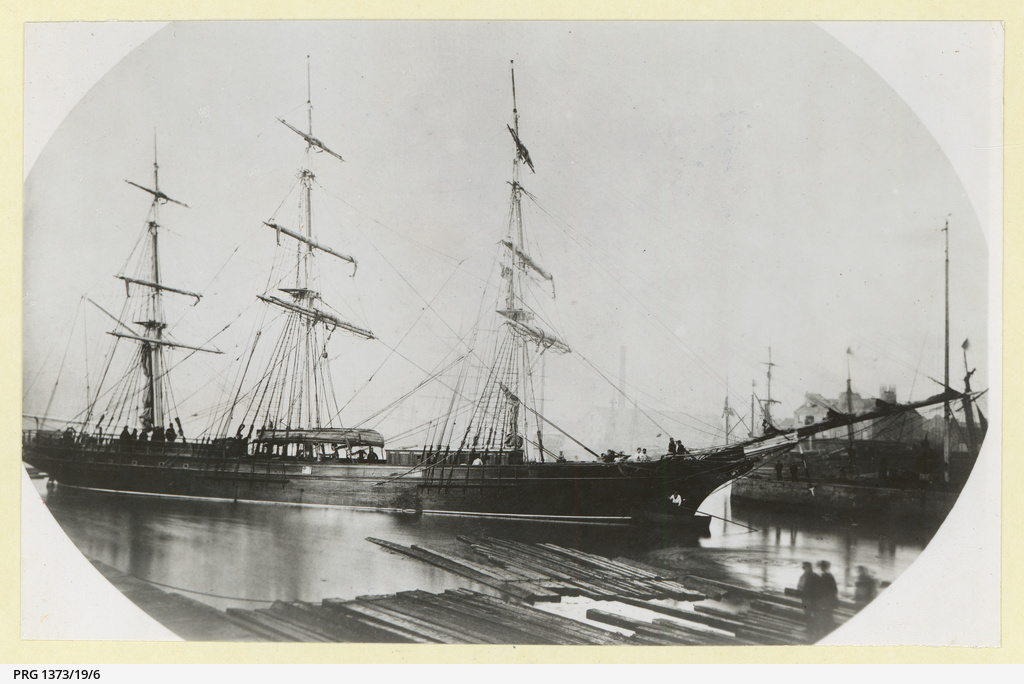
Wooden ship Umgeni, built 1864, 366 tons, State Library of South Australia, PRG-1373-19-6
JB Osgood, a merchant of Salem, was a part owner of the ship and also the manager of the vessel. The ship was used as a whaler and had visited the WA coast in 1837. Under the command of Francis Coffin and with a crew of 33, the Samuel Wright departed Salem on 4 May 1839 to go whaling in the Indian Ocean and along the southern coast of Australia. It called at Albany in March 1840. By the time it anchored in Koombana Bay in July 1840, it had obtained 30 tuns of sperm oil, 36 tuns of black oil and 5 tons of whalebone.
The Samuel Wright is one of five wooden wrecks buried on the Koombana Bay foreshore.
Description
Ship; two decks, a square stern, billet head and no galleries
Size
Length: 110 ft (33.5 m) Beam: 28 ft (8.5 m) Depth: 13.7 ft (4.2 m) Tonnage: 372 gross
Built
Portsmouth, New Hampshire, USA
Location
Koombana Bay, Bunbury
Latitude/Longitude
(-33.322233, 115.649211)
Sinking
On 7 July the breeze freshened from the north-east in the evening, increasing and shifting north-north-east. By midnight there was a storm. The Samuel Wright rode the storm until seas were breaking over the topmast head and a chain anchor cable parted. The ship now had two anchors down but they were not sufficient to prevent it from dragging. The crew brought up another, very large anchor that was stowed below decks, but before they could secure a cable to it, the Samuel Wright struck the beach some miles north of Bunbury. The wreck was sold at auction; it was bought by the master, Francis Coffin. He leased the ship as storage. By 1842 sand had been scoured out from under the ship and its back was broken.
Underwater
The Samuel Wright is now buried many metres under sand and lies under a carpark. It was first uncovered by minerals sands mining operations in 1962 and found to be standing almost upright, and lying in an approximately north-south direction. The wreck was later reburied.