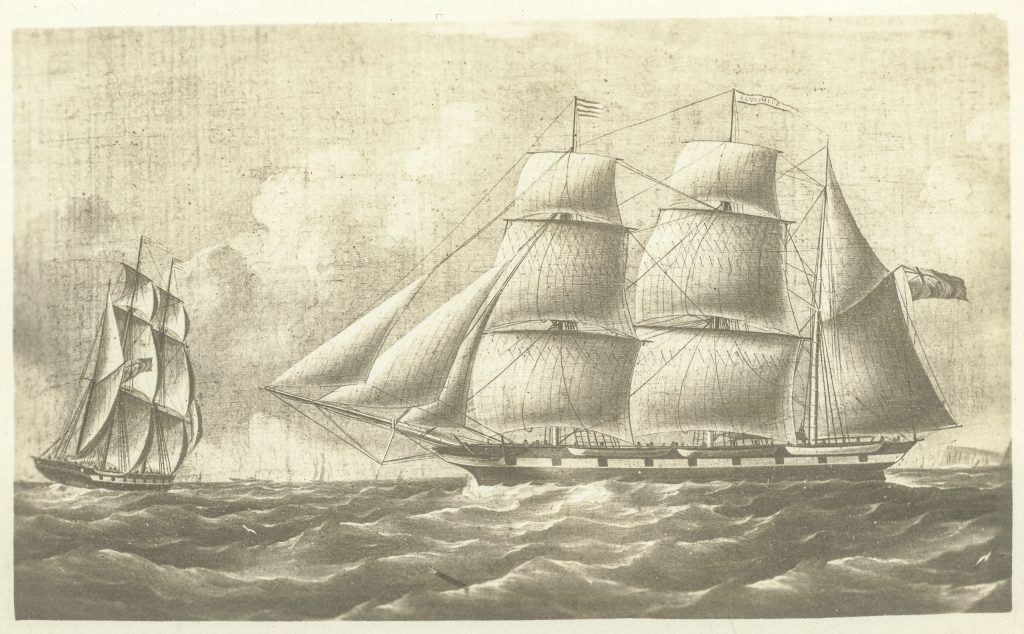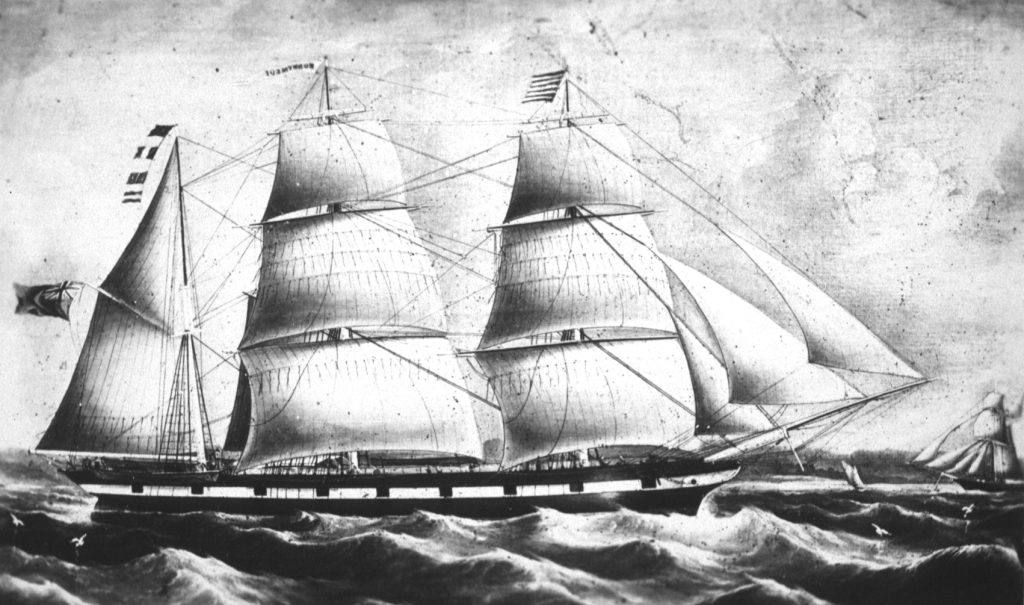
The Runnymede was built for James and Charles Bayley, who are closely associated with the beginning of whaling round Tasmania. On 27 October 1881 the Runnymede arrived in Albany for medical assistance.
RUNNYMEDE 1849–1881

Barque Runnymede, digitised item from the WL Crowther Library, State Library of Tasmania_643861
Description
Barque; two decks, a square stern and a scroll stem
Construction
Wood (Eucalyptus globulus)
Size
Length: 103.6 ft (31.6 m) Beam: 23.2 ft (7.1 m) Draft: 15.5 ft (4.7 m) Tonnage: 284
Built
John Watson at Battery Point, Hobart
Owner
Alex McGregor and James Bayley
Sunk
19 December 1881
Location
Frenchman Bay, Albany
Latitude/Longitude
(-35.084517, 117.937902)
Sinking
On Wednesday 14 December 1881 the Runnymede anchored in six fathoms (11 m) at Frenchman Bay to take on fresh water. A strong breeze became a gale on 18th. On Monday 19 December the starboard chain parted and the barque went ashore. The crew got ashore safely. The following day they were able to salvage stores and the whale oil. The Runnymede was declared a total wreck. From 20 December to 7 January the wreck was stripped of everything of value, including the masts and spars. In early 1882 William Jenkins Gillam of Albany bought the Runnymede with the intention of using it as a coal hulk. The barque was refloated but it was reported that it had been burned only 19 days later – the damage was probably more severe than initially thought, and the wreck was burned for the metal fastenings.
Underwater
The Runnymede lies in the intertidal zone on Goode Beach, close to but southward of the wreck of the Fanny Nicholson. The wreck lies parallel to the beach and is almost always covered in sand. Occasionally the sand shifts enough for the upper part of the wreck to be seen in 1–2 m of water. A substantial part of the below-waterline section of the hull is believed to be in good condition.
Gallery