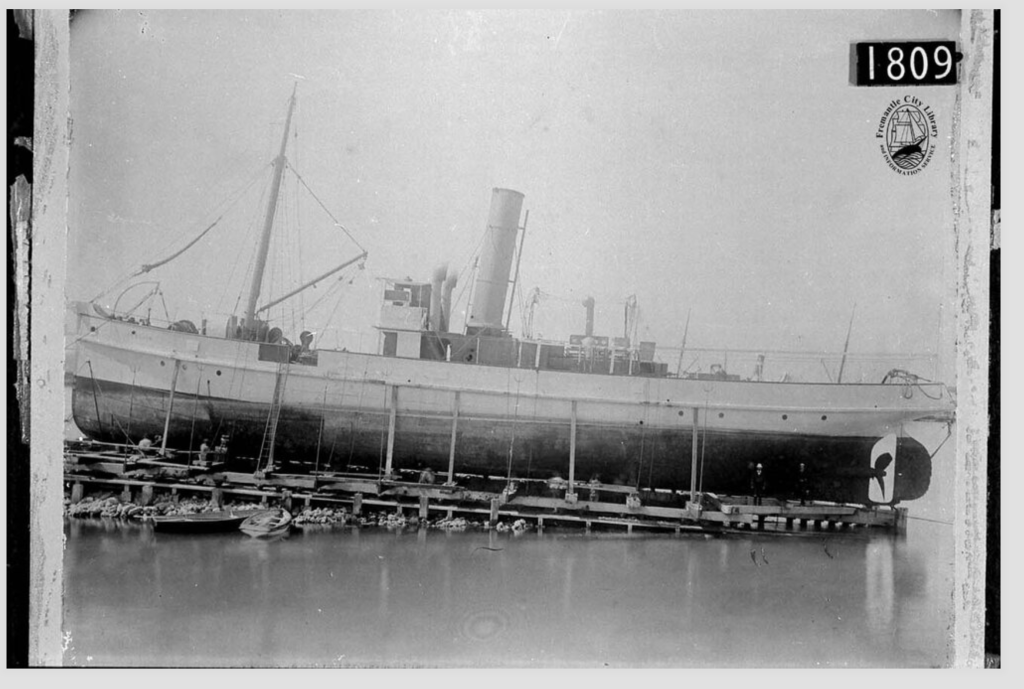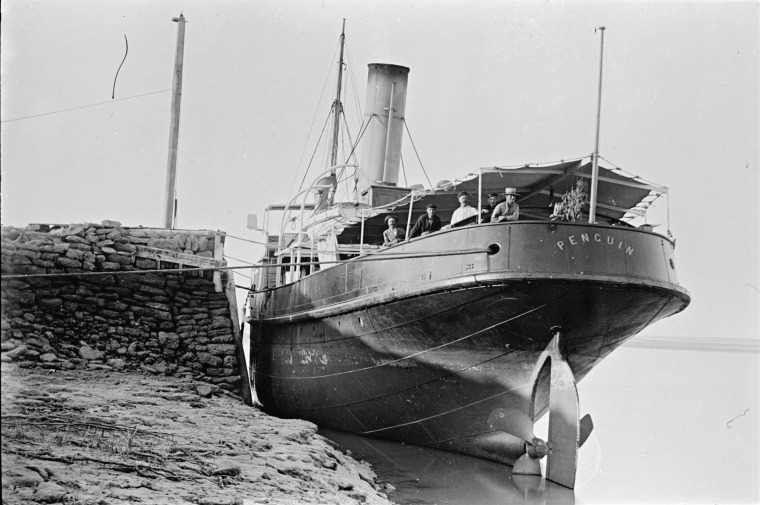
The Penguin was built for the Western Australian government. During World War I the Penguin was used as a coastal patrol vessel under the name of HMAS Gannet. The name reverted to Penguin after the war.
PENGUIN 1897–1920
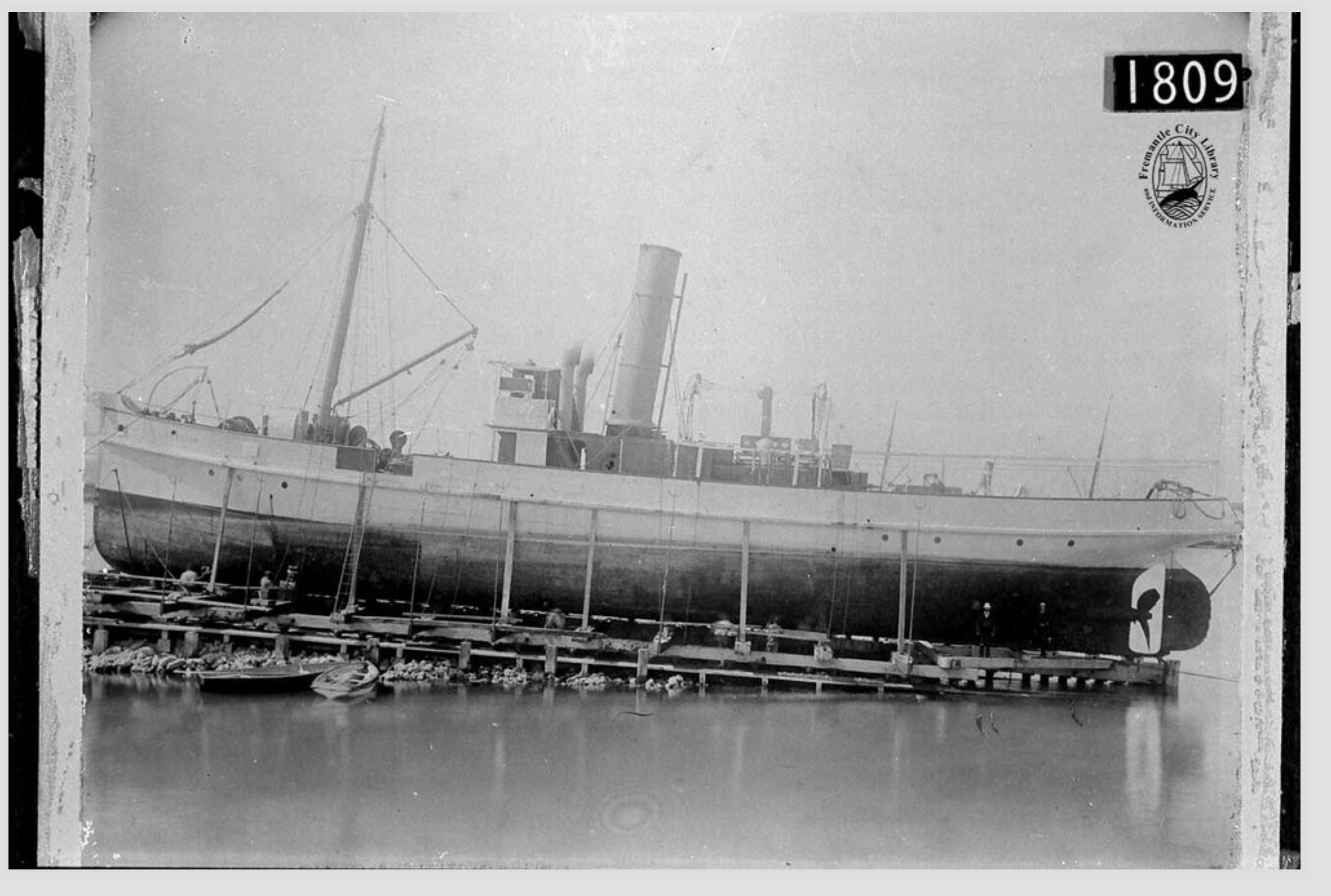
Penguin on North Mole slipway, c. 1899. Image courtesy of City of Fremantle History Centre LH001809
Description
Steamer, ketch-rigged; triple expansion compound steam engine of 44 hp
Construction
Steel
Size
Length: 120.0 ft (36.6 m) Beam: 24.1 ft (7.35 m) Depth: 11.4 ft (3.48 m) Tonnage: 208.16 gross, 60 net, 205 under deck
Built
Palmers Shipbuilding and Iron Company of Newcastle, England
Owner
WA Government
Sunk
27 June 1920
Location
Goose Island Bay, Middle Island, Recherche Archipelago
Latitude/Longitude
(-34.09105, 123.20727)
Sinking
In 1920 the Penguin was fitted with an insulated fish room, in which fish were to be stored on ice. The Penguin arrived in Albany on 13 June 1920, and then carried on to conduct a fishing survey in the Recherche Archipelago and Great Australian Bight. The Penguin was 90 miles offshore when a gale struck. The captain sought shelter at Middle Island, where the Penguin anchored. Heavy rain and gale force winds continued. The wind changed direction and blew the Penguin onto a reef. The stern was badly holed and under water, so it was considered that the Penguin could not be saved.
Underwater
Extensive salvage work was undertaken after the wrecking. By 1922 all that was left was most of the hull and some engine parts. The top of the boiler and a section of the hull (probably part of the bow) project above sea level close to the shore.
Gallery