Description: A large Iron Hull three-masted barque. By the end of its life, it was one of the many international vessels participating in the West Australian timber trade.
NOR’WESTER (1864–1900)
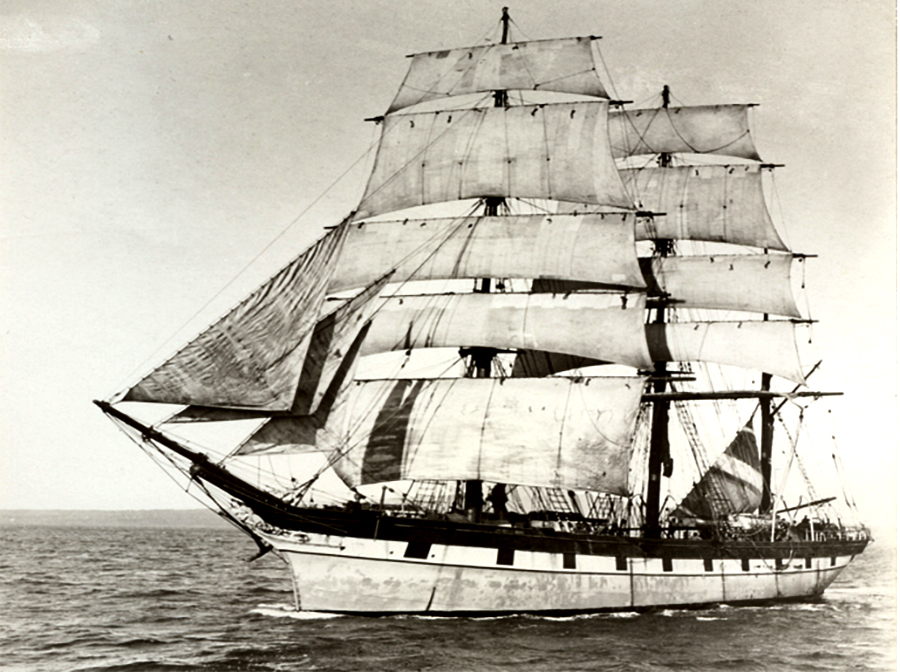
A Barque similar to the Nor’wester
Description
Had one deck, one bulkhead, two tiers of beams and was cemented. The barque had a forecastle with a length of 7 m and a poop 10.67 m long.
Construction
Iron Hull
Size
Tons: 567 gross tons Length: 49.8 m (163.5 ft) Breadth: 8.9 meters (29.2ft) Depth: 5.1 m (16.8 ft)
Built
Built 1864 under special survey by L Hill and Co. in Glasgow, Scotland.
Owner
In 1888 the vessel had been owned by J. & A. Roxburgh of Glasgow, but at the time it was wrecked the owner was A. Claasen.
Sunk
The Nor’wester, under the command of Thomas H. Neilsen with a crew of twelve, had arrived at Hamelin Bay June 1900. It was tied to the Hamelin Bay Jetty along with the barques Katinka and Lövspring. No cargo had been taken on board, so the barque was riding high in the water. The captain also had his two daughters, Katherine and Atlantic, on board
Location
Refloated and towed to Fremantle
Latitude/Longitude
(−34.212550, 115.023467)
Sinking
One of the most severe storms to hit the South-West occurred in July 1900. This storm occasioned much damage and caused the loss of three vessels and the stranding of a fourth, the Nor’wester, in the bay. There were two phases to the storm—the first phase with winds from the north-north-west on 22 July, and a second phase when winds swung round to the south-west the following day. The Nor’wester was stranded during the first phase of this storm. The barque was moored to the south side of the jetty when the storm struck. Being empty, the barque rolled, at times nearly capsizing, and the massive strain caused the bow hawser to part about midday on 22 July. The other lines then also gave way. In its passage towards the beach the vessel hit the wreck of the Arcadia, which had been blown ashore earlier that morning, resulting in severe damage to the Nor’wester’s hull. The hurricane force wind then swung to the south-west, driving the wreck further into the shallows between the jetty and the Arcadia. By 3.00 p.m. the barometer was reading 29.089 inches (985.1 hPa), and kept at that steadily for four hours. The following morning the crew managed to get ashore safely in the ship’s lifeboat, then made an attempt to re-launch the boat to go to the aide of the survivors clinging to the rigging of the Katinka, but the heavy seas defeated them. However, the lifeboat from the Lövspring managed to rescue the survivors from the wreck.
Underwater
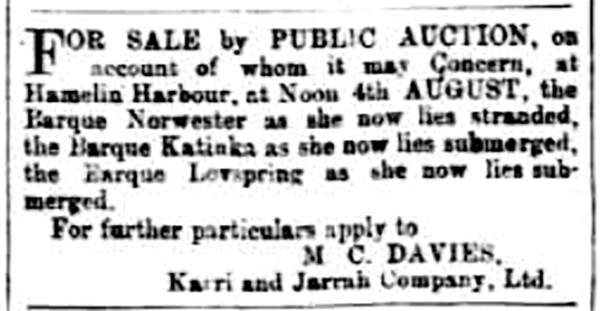
After being surveyed by Captain Webster, the Lloyd’s surveyor from Fremantle, the Nor’wester was sold at a public auction for £21 to Maurice Coleman Davies, the local timber merchant who was to supply the cargo. After several attempts the barque was refloated and towed by the tug Awhina to Fremantle. Davies’ intention was to repair the vessel to Lloyd’s A1 standard, and have it sailing again at an estimated cost of £400–£500. However in December he sold the barque to the Adelaide Steamship Company for use as a hulk, and it was towed to Adelaide by the steamer Rob Roy in early 1901.
Gallery