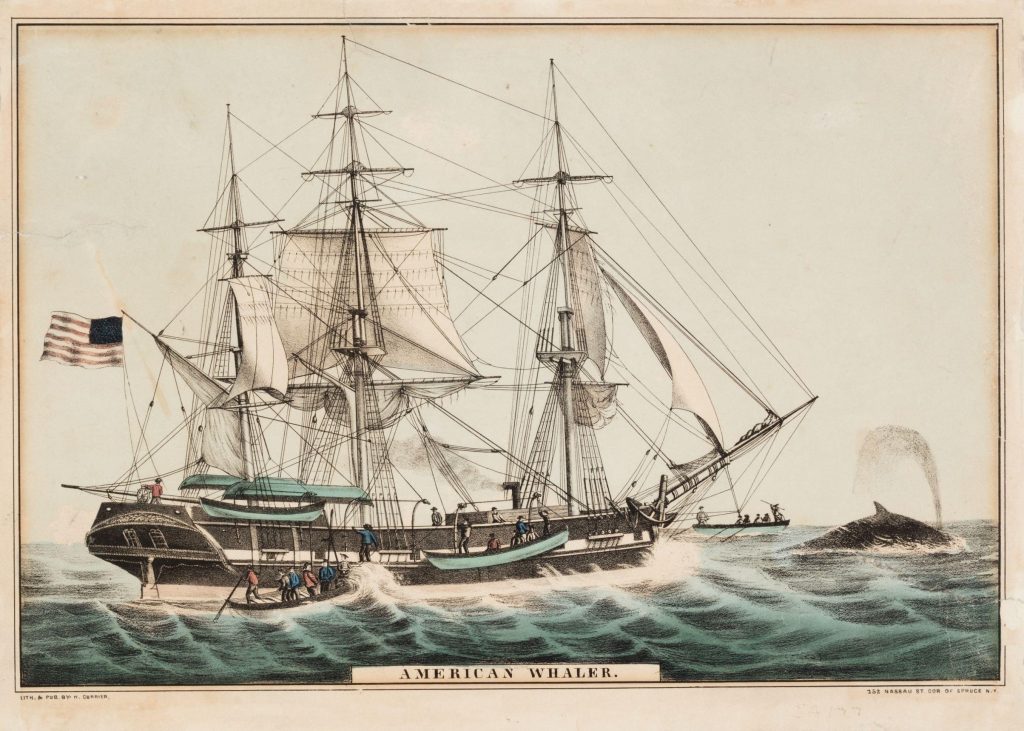
The American whaler North America sailed under the command of Captain Kempton with a crew of 25 from Wilmington, Delaware, on 6 December 1839. The ship had made at least one previous voyage to Australian waters. The North America was at anchor in Koombana Bay on 6 July 1840, along with two other American whalers, the Samuel Wright (Francis Coffin) and the Hudson (Captain J Denison), and the weather was changing.
NORTH AMERICA (1) 1834–1840
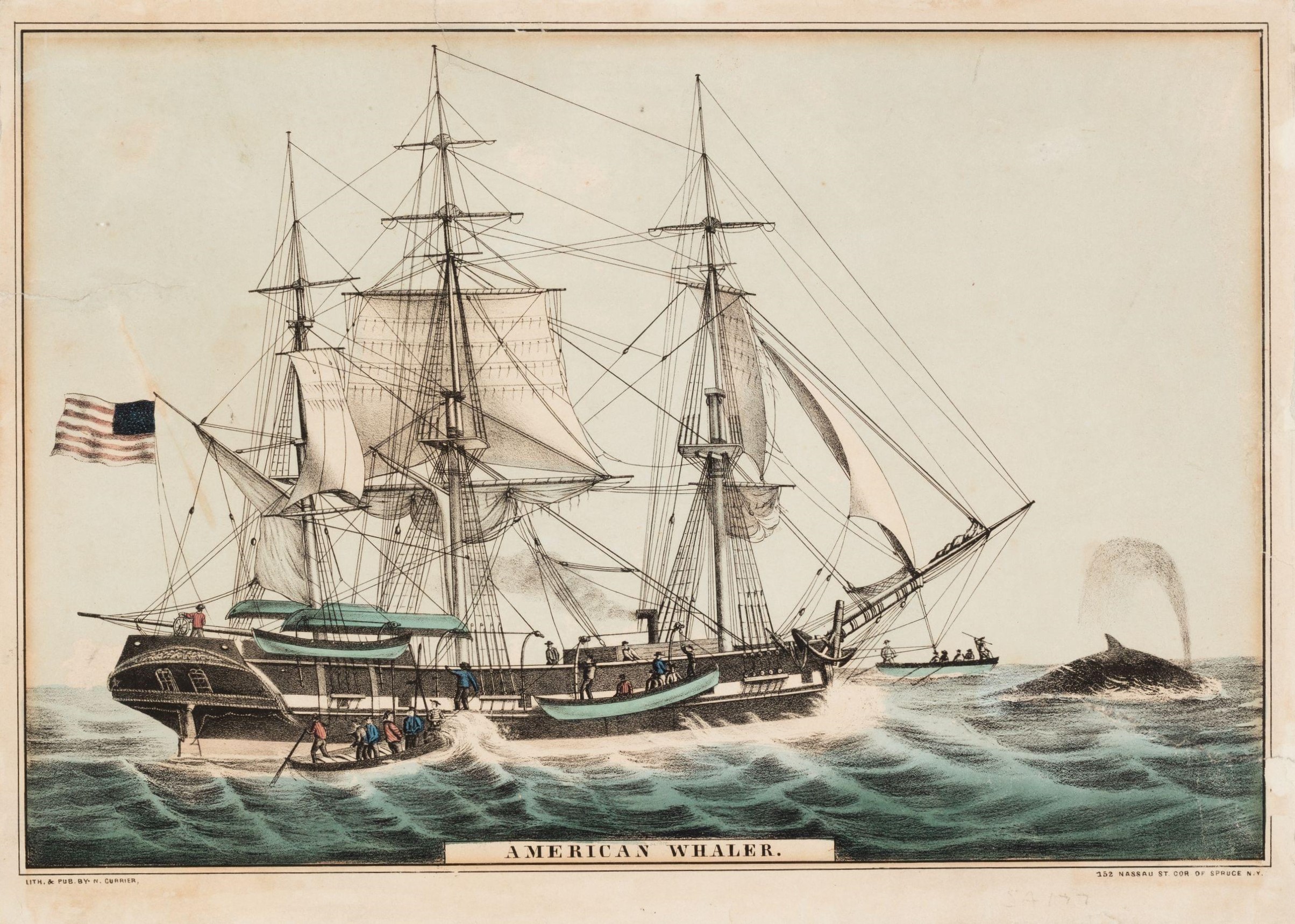
A wooden American whaling ship: from a French lithograph, CA, 1860 (a copy of a Currier and Ives lithograph), in the Macpherson Collection. AF-SA-0177
Description
Ship rigged; two decks, a square stern and a billet head
Construction
Wood
Size
Length: 103.19 ft (31.45 m) Beam: 24.06 ft (7.33 m) Draft: 4.0 m Tonnage: 270.43
Built
Scarborough, Maine, USA
Owner
William Wheeler
Sunk
8 July 1840
Location
Koombana Bay
Latitude/Longitude
(-33.322229, 115.650462)
Sinking
On the evening of 7 July 1901 the breeze freshened from the north-east, increasing and shifting north-north-east. About sunrise on 8 July the wind shifted to the north, and at 8 am went to the north-north-west and blew with ‘unmitigated fury’. The North America was blown onto the shore and was bilged the second time it struck. The wreck was advertised for sale and was bought by John Randall Phillips for £400, which included the whale boats and gear. Whale oil and bone salvaged from the wreck was also sold. References suggest that the North America was substantially dismantled by Phillips and disappeared as a landmark.
Underwater
The site of this wreck is not known. Magnetometer surveys undertaken by the Western Australian Museum in 1982 produced anomalies at a number of different sites, one of which may possibly be the scant remains of the North America. These surveys, and reports by local residents, indicate that it is buried under metres of sand well inland from the present shoreline.
Gallery