
The Mary was launched in December 1868, and was described as being an exceedingly smart craft. The first owners were the builder, James Storey, (16 shares), William Miles (16 shares) and William and George Pearse (jointly owning 32 shares). The schooner changed hands several times. It was used for trading along the Western Australian coast and carried cargoes such as pearl shell and wool from north-west ports and timber from the south-west.
MARY 1868–1879
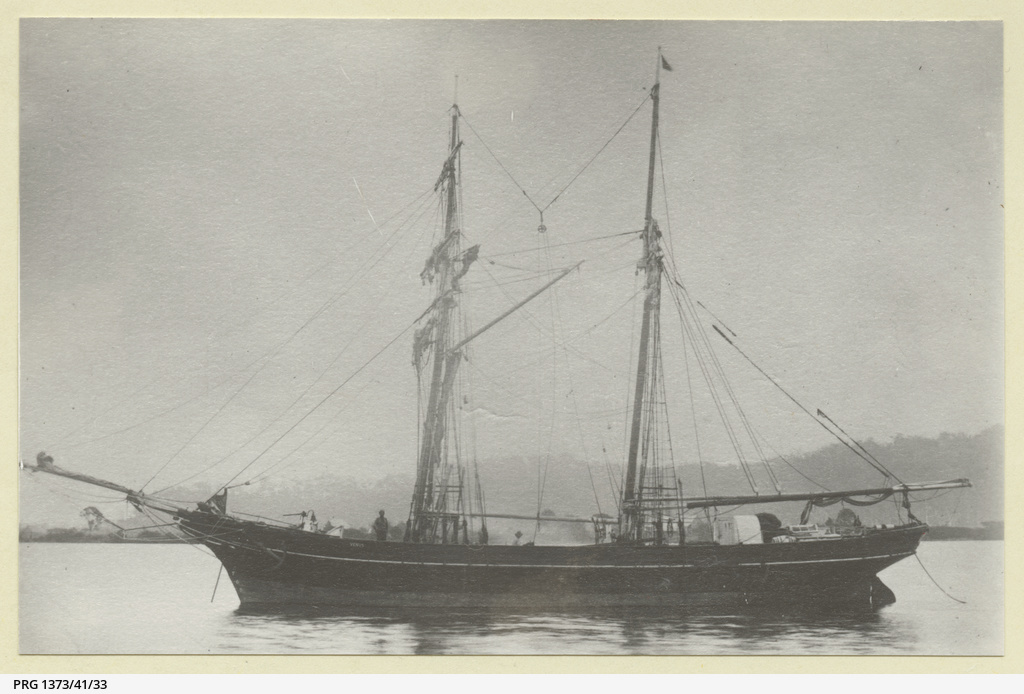
A wooden schooner of 38 tons, AD Edwards Collection, State Library of South Australia, PRG-1373-41-33
Description
Schooner; one deck and an elliptical stern
Construction
Wood
Size
Length: 65.6 ft (20 m) Beam: 17 ft (5.2 m) Draft: 7.6 ft (2.32 m) Tonnage: 48.5 gross, 46.85 under deck
Built
James Storey, Fremantle
Owner
William Edward Marmion, John Tuckey and Samuel Pearse
Sunk
5 June 1879
Location
Lockeville jetty
Latitude/Longitude
(-33.617207, 115.409537)
Sinking
Approaching bad weather caused the Mary to seek shelter at Lockeville and she was tied up alongside the jetty. As the weather worsened the schooner was removed to the West Australian Timber Company’s mooring about 180 m from the jetty. By 2.00 am the next day heavy seas were breaking over the vessel and the mooring dragged. The Mary hit a jetty pile and then went broadside on to the jetty. In this position it was impossible to manoeuvre the vessel into the lee of the jetty, so Waldron payed out cable so the schooner could be backed gradually into shallow water. After striking the bottom a number of times the masts fell. The crew then scuttled the vessel to steady it and diminish the pounding but the vessel became a complete wreck.
Underwater
The remains of the Mary lie close to the jetty piles, about 40 m from the shore. When the site was inspected by the Western Australian Museum in December 1970, the keel and sternpost of the Mary were visible, together with some frames projecting above the sand, a heap of ballast stones and some planking. An inspection in February 1989 showed that much of this material had either disappeared or been buried under the sand.
Gallery