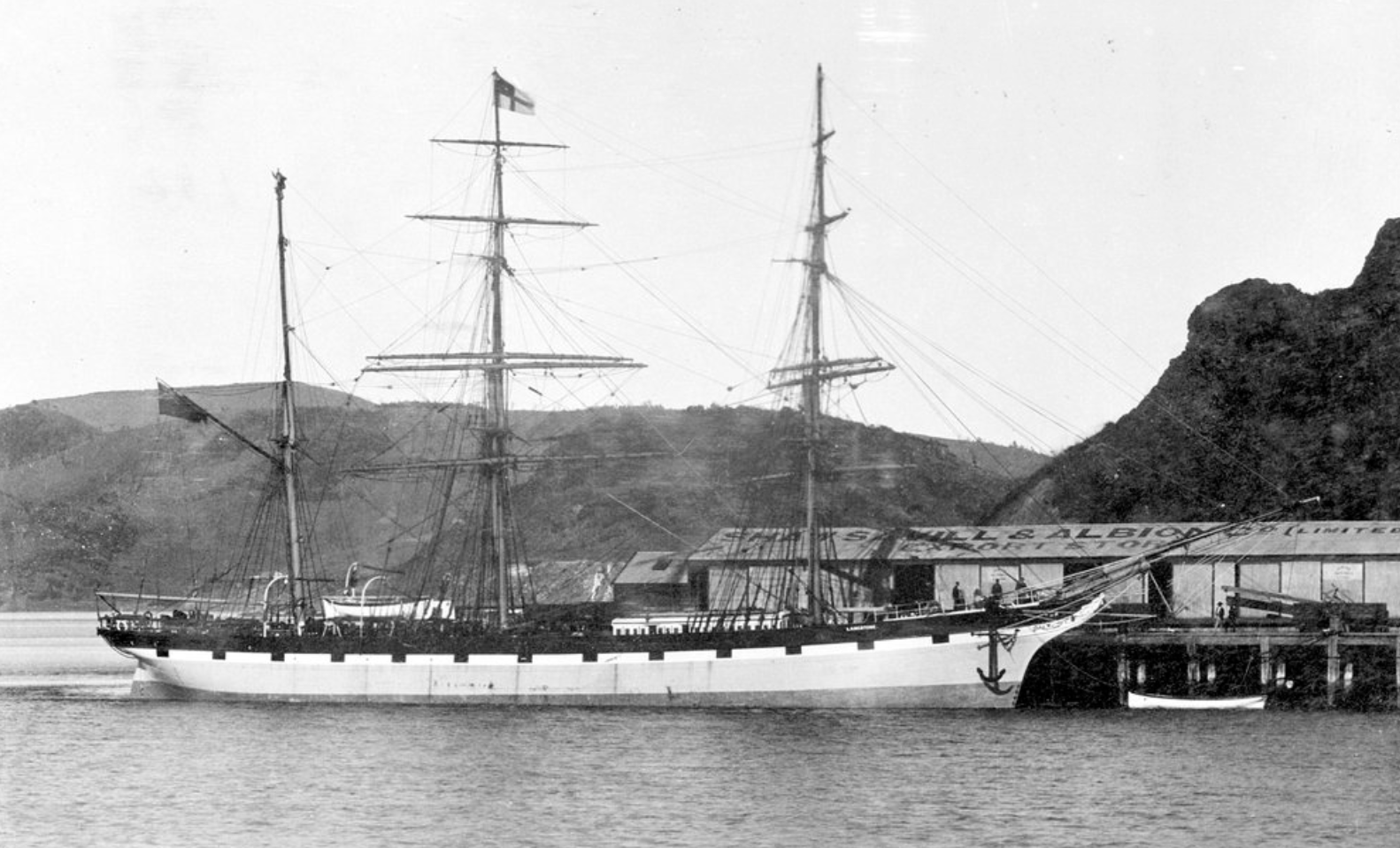
By 1875 the Langstone was owned by James William Temple of London. By 1882 it was owned by the Shaw, Savill & Albion Co. Ltd, also of London. The barque was owned by CB Mönck of Fredrikstad by 1895, and he was the master when the barque (now called Langston) arrived in Western Australia for the first time in December 1901. It had a crew of thirteen.
The Langston had loaded timber from Millars Karri and Jarrah Timber Co. at Bunbury and was ready to sail for London on Friday 7 February 1902. Mönck adhered to the age-old sailors’ belief that to sail on a Friday was unlucky and delayed his departure. The barque and its cargo, with a total value of £4,000, was fully insured.
As the Langston was a foreign owned vessel, there was no official investigation into the wrecking, but a consular inquiry was held.
The survivors reached the shore some 48 km north of Bunbury near Lake Preston. They spotted the home of Mr and Mrs Salter, who took them in and gave them shelter for the night. The following day, Monday 10 February, the captain and some of the crew were taken to Bunbury by another settler, Arthur Jones, in his buggy. There they reported the wreck to the resident magistrate, WH Timperley.
One crew member had died and a coroners inquest was held on 12 February at the Bunbury Courthouse. A jury consisting of JG Baldock, Harry Brashaw and Arthur Charles Cook came to the conclusion that the ‘deceased came to his death by drowning while in the state of unconsciousness and that no blame could be attached to any person’.
Description
Barque; one deck, one bulkhead, two tiers of beams and was cemented. It had a forecastle with a length of 7.32 m and a quarterdeck 13.72 m long.
Size
Length: 56.80 Beam: 9.50 Draft: 6.00 Tonnage: 766 gross, 724 net, 715 under deck
Built
William Pile Jnr, Sunderland, England
Owner
CB Mönck of Fredrikstad
Location
Off Naturaliste Reef, 25 miles from Cape Naturaliste
Latitude/Longitude
(-33.216989, 115.033462)
Sinking
The Langston departed Bunbury at 6.30 am on Saturday 8 February 1902. The morning was fine, but at noon a gale began from south-south-west to south-west with a heavy cross sea running. The first mate, Carl Sunbye, later told a reporter: ‘When off Cape Naturaliste some 15 miles the captain gave instructions to lie out to windward—that is westerly—so to be well clear of the reefs.’ Captain Mörck had been watching out for the Naturaliste Reef, which he anticipated should be awash, but with heavy seas breaking it was impossible for him to see the break on the reef. At about 2 pm Mönck suddenly picked up the reef right in front, but it was too late and the Langston went crashing over the rocks. The barque immediately began to go down and, on sounding, the hold had made nine feet of water in a few minutes. The captain gave the order to clear away the boats. Three boats were lowered but one immediately filled with water and because of the rough seas it could not be bailed out. The second mate, Johann Weiseth, and seven of the crew got into the lifeboat, and the captain, first mate, steward, carpenter and a seaman went in a smaller boat. The Langston lay for a minute or so with the keel vertical, bow down and only the poop, mizzen mast and part of the keel visible, before slipping beneath the waves into deep water. From the time the Langston struck to the time the boats were lowered was ten minutes, and it sank only ten minutes after that in 23 fathoms (42 m) of water.
Underwater
The exact location of the Langston is unknown. It seems most probable that the Langston struck the southern section of the Naturaliste Reef.