
The P&O Steam Navigation Company bought the Kingfisher in 1859, only five years after it was launched, with the intention of using it as a coal hulk at Albany. Its short life as a trading barque was presumably due to its light construction.
KINGFISHER 1854–1905
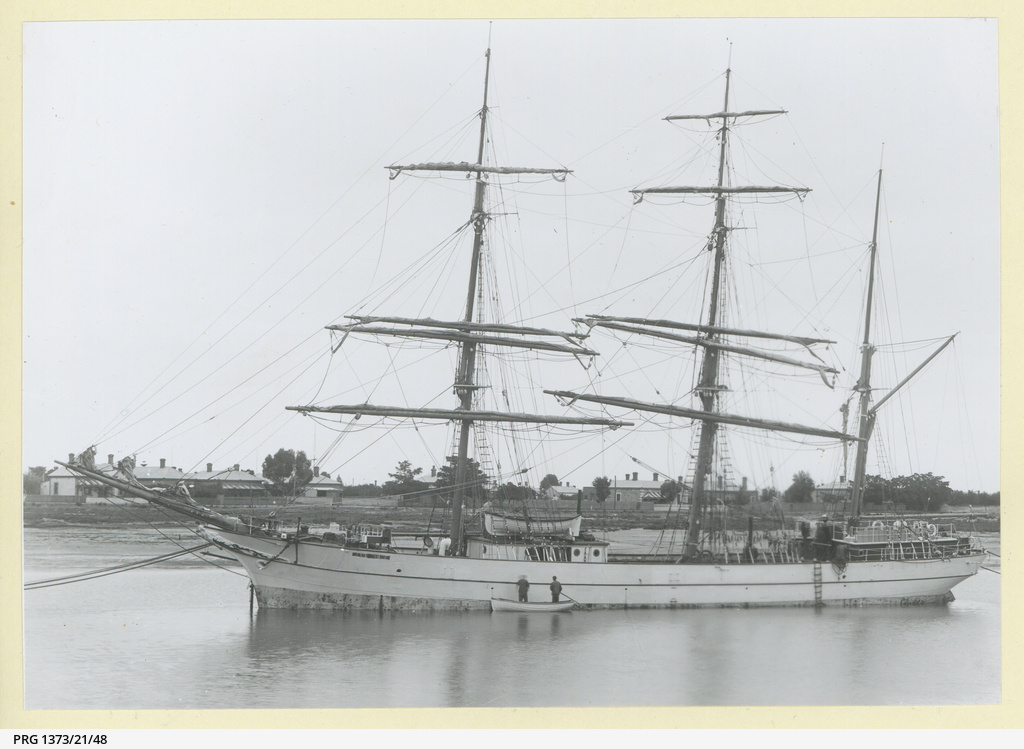
Iron barque Vale Royal, State Library of South Australia, PRG-1373-21-48
Description
Barque; one deck, round stern, and was lightly built
Construction
Iron
Size
Length: 120.33 ft (36.68 m) Beam: 18.66 ft (5.69 m) Tonnage: 164 gross
Built
Hoby, Renfrew, Scotland
Owner
Final owner: P&O Steam Navigation Company
Sunk
9 March 1905
Location
South of Melville Point at the western end of Princess Royal Harbour
Latitude/Longitude
(-35.03282, 117.869532)
Sinking
A severe storm in 1905 drove the Kingfisher to where it currently lies. By this time the barque had outlived its usefulness, so it was abandoned.
Underwater
(1992) The Kingfisher lies upright in shallow water with the lower section of the hull, which lies on an east–west axis, buried in the sandy bottom. Almost all the hull above the high water mark has disintegrated or collapsed. The most prominent feature is the stern post. Some frames and the stem post are also visible. The iron is covered in marine growth. Under the sand a considerable portion of the wooden ceiling is in a good state of preservation. A winch is visible in front of the wreck. Remains of the Kingfisher may be seen south of Melville Point at low tide.
Gallery