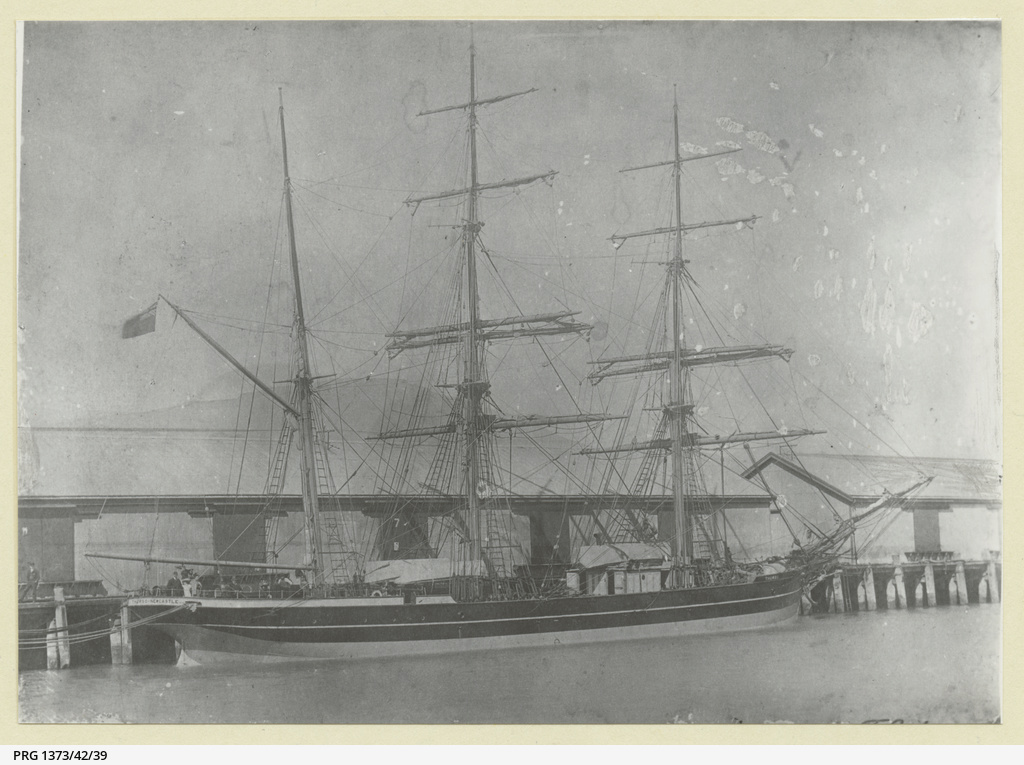
The Hokitika was built by Alexander Hall & Sons as yard number 268 at a contract price of £3,950. It was launched in November 1871. The Hokitika’s first voyage for its owners was a cargo of 426 tons of coal from Newcastle, NSW, to Mauritius. It left Newcastle on 7 October 1872 under the command of Captain Samuel Findlay and with eleven crew.
Findlay had been around Cape Leeuwin on ten previous occasions. His chart was dated 1858.
The Hokitika struck an unknown object off Cape Leeuwin on 2 November 1872 and sank in about 45 minutes. No blame was attached to the master, mate or any of the crew at the subsequent inquiry, but questions were later asked about the reliability of the evidence and sobriety of the master and mate.
Police constable Thomas Stack arrived at Augusta on 15 November under instruction to search for the wreck of the Hokitika and to place any property from the barque above the high-water mark. On the beach he found a water barrel, planks and half a yard with some rigging still attached. He also obtained eight cabin doors, a chest of drawers, two chairs, part of a bed and some planks, which had been collected by Michael Bredy [Brady?] and his wife. He did not find the wreck.
On 26 February 1873 police from Quindalup travelled to Augusta to collect further articles that had come ashore.
The only other items saved from the wreck were the two boats in which the survivors reached shore. They were later sold at Busselton.
Description
Barque; one deck, a round stern, one bulkhead, no galleries and a female demi-figurehead; and was cemented
Size
Length: 40.40 m Beam: 7.60 m Draft: 3.70 m Tonnage: 283 gross
Built
Alexander Hall and Co., Aberdeen
Owner
John and David Spence, Melbourne
Location
Off Cape Leeuwin. There are doubts about the location of the wreck. The second mate thought that the Hokitika was about 11–13 km from land when it sank. A report by Constable Richard Furlong stated that Captain Findlay reported to him that the Hokitika went down about 9 km from shore.
Sinking
At noon on 2 November 1872 the Hokitika was estimated to be 10 or 12 miles off Cape Leeuwin. A bearing taken at that time by the second mate, James Hunter, showed Cape Leeuwin bearing N by E (11°). The vessel was heading NW by ½W (about 310°), and it was doing 8 knots. The course was maintained until 3.00 pm, when the vessel struck twice without warning. There was a heavy swell running and nothing to indicate shoal water. The pumps were manned, and a sounding showed 0.9 m of water in the hold. Within 20 minutes the water had risen to 1.83 m. The barque immediately stood in for the land, and a short while later had 3.2 m of water in the hold. About 45 minutes after striking, the Hokitika sank in about 55 m of water some 8 km offshore. The crew launched the two boats and reached shore near a small creek, probably Turner’s Brook just south of Cape Hamelin. The following morning they headed north and reached Busselton at noon on 5 November 1872.
Underwater
The Hokitika has not been found.