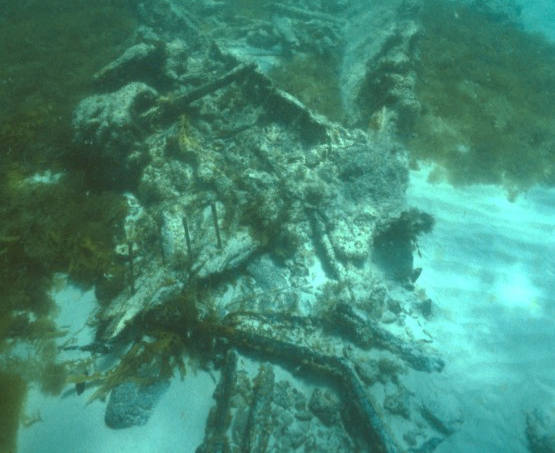
Agincourt was built by William Doxford under Special Survey and launched in January 1863. It was copper-fastened, sheathed with felt and yellow metal, and had a raised quarter deck 12.5 m long. The vessel had been owned by various UK owners until 1880, when it was purchased by a Mr MacGregor of Adelaide.
AGINCOURT (1863-1882)
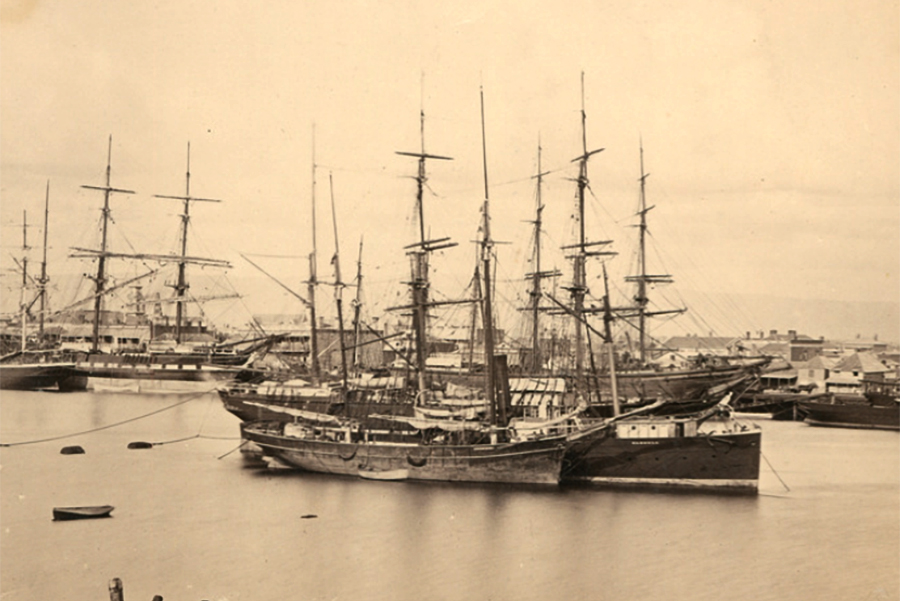
Looking across the Port River from Birkenhead to Queen’s Wharf. The steamer inside this ketch is the SS “Glenelg”. Inside the “Glenelg” is the barque “Agincourt”. SLSA
Description
Timber three masted Barque, copper-fastened, sheathed with felt and yellow metal, and had a raised quarter deck 12.5 m long.
Construction
Timber with yellow metak sheafing
Size
443 tons 40.2m length 8.7m beam 5.5m draft
Built
Launched 1863 built by William Doxford, England
Owner
Mr MacGregor of Adelaide. Subsequent owners were the partners W.L. Dickson, C. Russell and E. Trevett, Captian
Sunk
Agincourt had arrived in Hamelin Bay on 17 February from Adelaide. The barque, under the command of Henry Patching with a crew of eight, had anchored ‘five cables from the jetty in five fathoms water… the jetty was bearing S½E and Edith Ledge bearing N by W½W’ (Captain Patching’s evidence, CSO1455/64). On 19 April it was loaded with timber and ready to sail. The north-west breeze was moderate but later developed in to a gale, with a heavy swell from the same direction.
Location
The Agincourt is situated 900 m north of the boat launching ramp at Hamelin Bay, and 120 m offshore. It lies just south and inshore of Inside Rock;
Latitude/Longitude
(-34.2145683333, 115.03366)
Sinking
However with every swell the vessel began dragging so he stopped heaving ‘so as to give the ship the benefit of the cable that was then out’, a length of about 45 fathoms (82 m). At 12.45 p.m. the vessel struck Inside Rock. Immediate sounding of the pump well showed 18 in (0.46 m) of water which had increased to 26 in (0.66 m) within ten minutes. To save the vessel sinking into deep water he ordered the cables slipped and hoisted the fore topmast staysail to turn the Agincourt’s bow towards the shore, and beached the barque.
Underwater
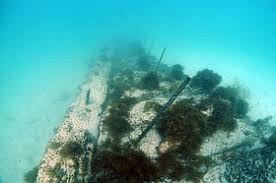
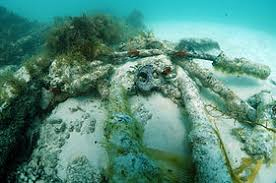
The wreck of the Agincourt lies on a sandy bottom on an axis of 104°, bows towards the beach, in 5–6 m of water. The lower part of the hull, which cants slightly to starboard, is intact. It has 95 mm thick planks with a ceiling inside of 70 mm planks.
Gallery